
http://edamontology.org
http://purl.obolibrary.org/obo/ncit.owl
http://purl.obolibrary.org/obo/obi.owl
https://loinc.org
https://nih-ncpi.github.io/ncpi-fhir-ig-2/CodeSystem/collection-type
https://nih-ncpi.github.io/ncpi-fhir-ig-2/CodeSystem/condition-type
https://nih-ncpi.github.io/ncpi-fhir-ig-2/CodeSystem/metadata-elements
https://nih-ncpi.github.io/ncpi-fhir-ig-2/CodeSystem/ncpi
https://nih-ncpi.github.io/ncpi-fhir-ig-2/CodeSystem/ncpi-family-types
https://nih-ncpi.github.io/ncpi-fhir-ig-2/CodeSystem/phenotypic-feature-assertion
https://nih-ncpi.github.io/ncpi-fhir-ig-2/CodeSystem/research-data-access-code
https://nih-ncpi.github.io/ncpi-fhir-ig-2/CodeSystem/research-data-access-type
https://nih-ncpi.github.io/ncpi-fhir-ig-2/CodeSystem/research-data-date-of-birth-method
This fragment is not visible to the reader
This publication includes IP covered under the following statements.
| Type | Reference | Content |
|---|---|---|
| web | cbtn.org | https://cbtn.org/ |
| web | cbtn.org | https://cbtn.org/publications |
| web | snomed.info | 428263003 |
| web | snomed.info | 415684004 |
| web | snomed.info | 410515003 |
| web | snomed.info | 261665006 |
| web | www.ncpi-acc.org |
IG © 2023+ NCPI FHIR Working Group
. Package ncpi-fhir-implementation-guide-v2#0.2.0 based on FHIR 4.0.1
. Generated 2026-03-09
Links: Table of Contents | QA Report |
| web | github.com | FHIR 101 is a tutorial inside a Jupyter notebook that was put together by some folks at the Kids First Resource Center. |
| web | fhir-drills.github.io | FHIR Drills |
| web | ga4gh.github.io | This uses the standard Patient Record extension inherited from the GA4GH PedigreeRelationship profile |
| web | gatk.broadinstitute.org | For maximum interoperability with other NCPI systems, prefer these three codes for genetic relationships in PED files : |
| web | ga4gh.github.io | While all 55 codes from the GA4GH KIN ontology are available, NCPI systems may not fully support relationships beyond the three core codes above. |
| web | zzz.bwh.harvard.edu | We chose the direction of the relationship to match PED files ( plink Harvard Medical School definition , Broad Institute definition ), which go from the individual to the mother and father. |
| web | gatk.broadinstitute.org | We chose the direction of the relationship to match PED files ( plink Harvard Medical School definition , Broad Institute definition ), which go from the individual to the mother and father. |
| web | gatk.broadinstitute.org | Family Relationships describe the relationship between two Participants. The core use case is to present biological parentage of a participant to support family / pedigree analyses. In this spirit, platforms should seek to provide minimally the information in a PED file : |
| web | ga4gh.github.io | GA4GH Family Relationships are defined in the GA4GH Pedigree FHIR IG specification. |
| web | ga4gh.github.io |
This NcpiFamilyRelationship
profile derives from
the GA4GH PedigreeRelationship
profile and uses codes from the GA4GH KIN ontology
. The profile includes all 55 KIN codes in its ValueSet and maintains the parent's required binding for full GA4GH compatibility.
|
| web | ga4gh.github.io |
This NcpiFamilyRelationship
profile derives from
the GA4GH PedigreeRelationship
profile and uses codes from the GA4GH KIN ontology
. The profile includes all 55 KIN codes in its ValueSet and maintains the parent's required binding for full GA4GH compatibility.
|
| web | ga4gh.github.io | Please note that the original GA4GH profiles were built using older tooling that wasn't intended for being published 'as is'. As a result, some of the links below will be invalid. Please use the GA4GH PedigreeRelationship instead. |
| web | edamontology.org | format and relatedFile.type should use EDAM terminology (i.e., codes) when available. Other file type code systems are allowed if a suitable EDAM code does not exist. |
| web | snomed.info | 428263003 |
| web | snomed.info | 415684004 |
| web | snomed.info | 410515003 |
| web | snomed.info | 261665006 |
| web | gatk.broadinstitute.org | For maximum interoperability with other NCPI systems, prefer these three codes for genetic relationships in pedigrees ( PED files ): |
| web | ga4gh.github.io |
KIN:027 ("isBiologicalMotherOf")
:
The relative is the biological mother of the patient.
|
| web | ga4gh.github.io |
KIN:028 ("isBiologicalFatherOf")
:
The relative is the biological father of the patient.
|
| web | ga4gh.github.io |
KIN:010 ("isMonozygoticMultipleBirthSiblingOf")
:
The relative and patient are monozygotic twins. For higher-order multiples
(triplets, quadruplets, etc.), create KIN:010 relationships between every
pair of individuals in the multiple. Since this is a non-directed relationship,
each pair requires two FamilyRelationship resources (A→B and B→A).
|
| web | ga4gh.github.io | The full KIN ontology provides 55 relationship codes including adoptive parents, step-relations, grandparents, and more. While all codes are available for use, NCPI systems may not fully support relationships beyond the three core codes listed above. |
| web | github.com | calkinsh |
| web | github.com | RobertJCarroll |
| web | github.com | JamedFV |
| web | github.com | brendagutman |
| web | github.com | ShahimEssaid |
| web | github.com | allisonheath |
| web | github.com | a-l-holmes |
| web | github.com | fiendish |
| web | github.com | liberaliscomputing |
| web | github.com | nicholasvk |
| web | github.com | znatty22 |
| web | github.com | torstees |
| web | github.com | bwalsh |
| web | github.com | aw3334 |
| web | fshschool.org | FSH School - This is a great resource for both reference and introductory material |
| web | fshschool.org | Sushi Tutoria - Walkthrough guide for creating a sushi project, creating a handful of profiles using sushi and building a formal IG website on your local system. |
| web | en.wikipedia.org | Variant of Camel case where the first letter of the string is always upper case |
| web | fshschool.org | Filenames of all kinds should contain no whitespace. There are rules determining how we must name content that gets merged into the various artifact pages which is described over at fshschool.org toward the bottom of that page. In order to clearly differentiate between these artifact components and the text narrative pages, those stand-alone narrative pages must exist in files named using snake case . |
| web | en.wikipedia.org | Filenames of all kinds should contain no whitespace. There are rules determining how we must name content that gets merged into the various artifact pages which is described over at fshschool.org toward the bottom of that page. In order to clearly differentiate between these artifact components and the text narrative pages, those stand-alone narrative pages must exist in files named using snake case . |
| web | en.wikipedia.org | Sushi will parse the filename and apply title case to construct a meaningful starting header and title. For titles where that doesn't work, such as fhir_basics which would incorrectly result in a title, Fhir Basics , contributors should add an appropriate entry to the sushi-config pages heading as can be seen in this example configuration . By assigning the title property for a given page, the contributor can provide any type of case as is appropriate. |
| web | fshschool.org | Sushi will parse the filename and apply title case to construct a meaningful starting header and title. For titles where that doesn't work, such as fhir_basics which would incorrectly result in a title, Fhir Basics , contributors should add an appropriate entry to the sushi-config pages heading as can be seen in this example configuration . By assigning the title property for a given page, the contributor can provide any type of case as is appropriate. |
| web | github.com | The FSH code for the CBTN example can be found in the NCPI FHIR IG 2 repository at ncpi-fhir-ig-2/input/fsh/examples or with this direct link . |
| web | github.com | The FSH code for the GREGoR example can be found in the NCPI FHIR IG 2 repository at ncpi-fhir-ig-2/input/fsh/examples/GREGoR_example.fsh or with this direct link . |
| web | ga4gh.github.io |
We align with the work done by GA4GH to model family relationships via the Pedigree IG
. Our NcpiFamilyRelationship profile derives from the GA4GH PedigreeRelationship profile and uses codes from the KIN ontology
. While all 55 KIN codes are available for full GA4GH compatibility, NCPI recommends a canonical approach using three core codes ( KIN:027
( isBiologicalMotherOf
), KIN:028
( isBiologicalFatherOf
), KIN:010
( isMonozygoticMultipleBirthSiblingOf
)) that can express all pedigree relationships when combined with inferred individuals.
|
| web | ga4gh.github.io |
We align with the work done by GA4GH to model family relationships via the Pedigree IG
. Our NcpiFamilyRelationship profile derives from the GA4GH PedigreeRelationship profile and uses codes from the KIN ontology
. While all 55 KIN codes are available for full GA4GH compatibility, NCPI recommends a canonical approach using three core codes ( KIN:027
( isBiologicalMotherOf
), KIN:028
( isBiologicalFatherOf
), KIN:010
( isMonozygoticMultipleBirthSiblingOf
)) that can express all pedigree relationships when combined with inferred individuals.
|
|
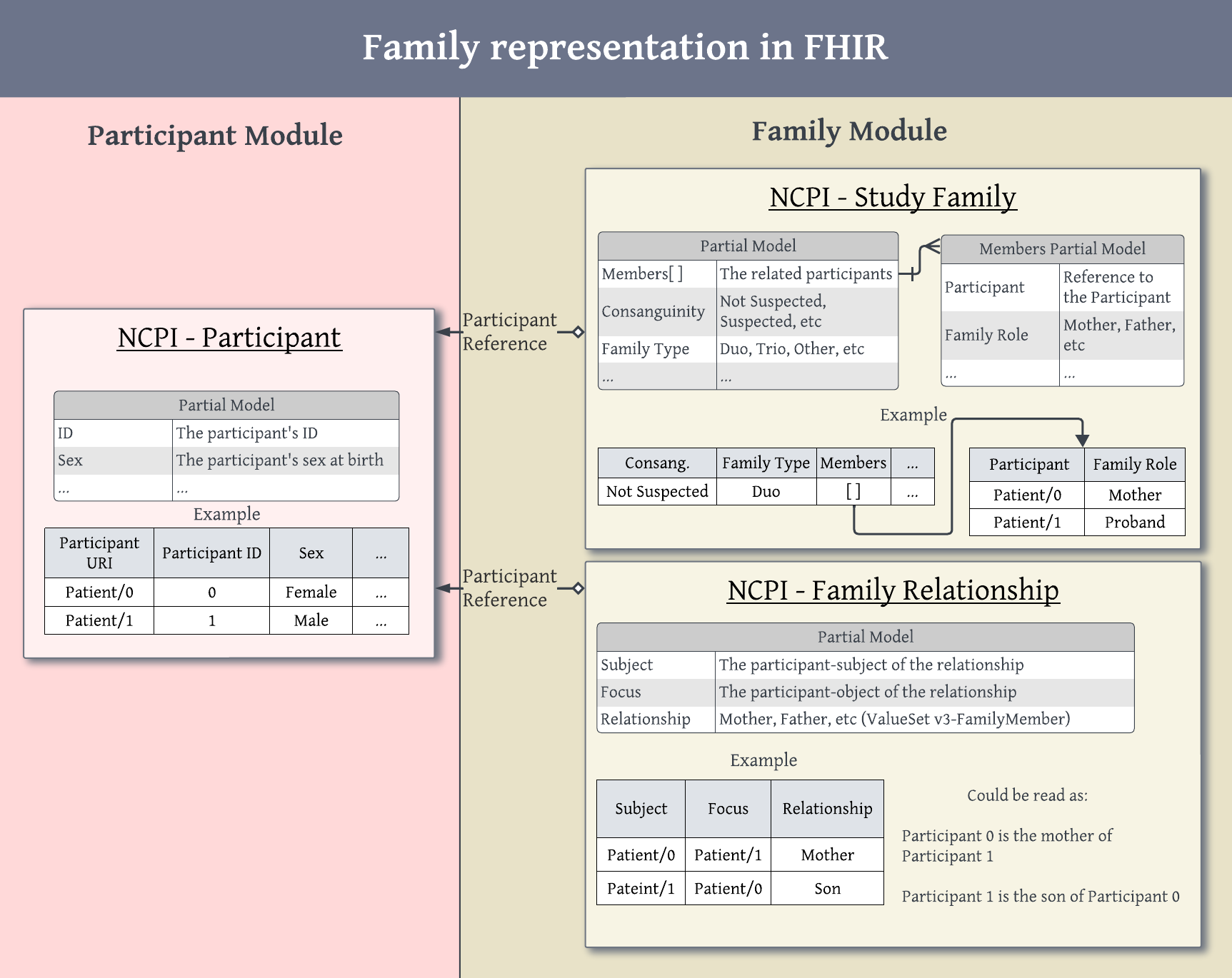
ncpi_family_module_relationships.png
|
|
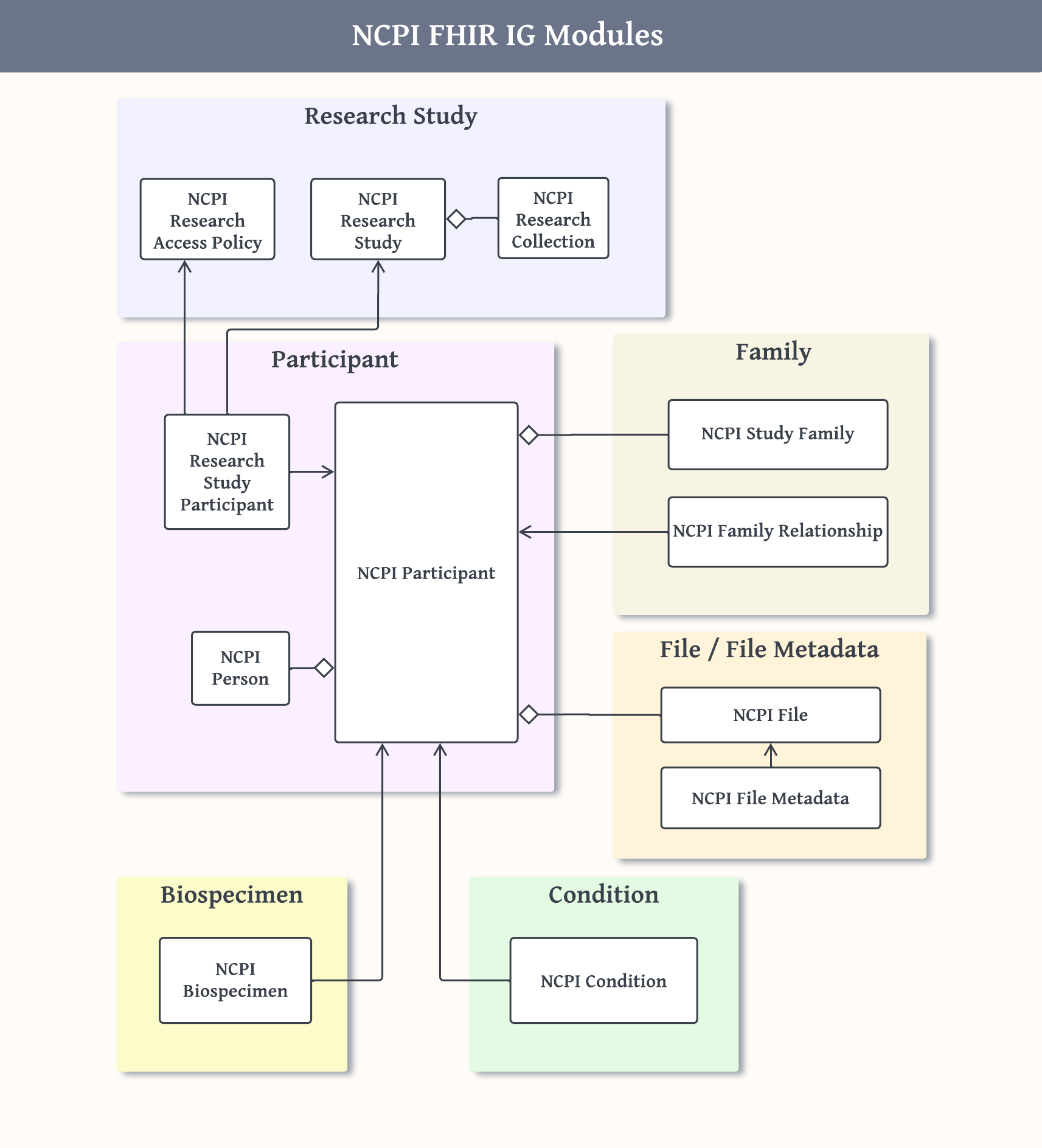
ncpi_modules_relationship_overview.png
|
|
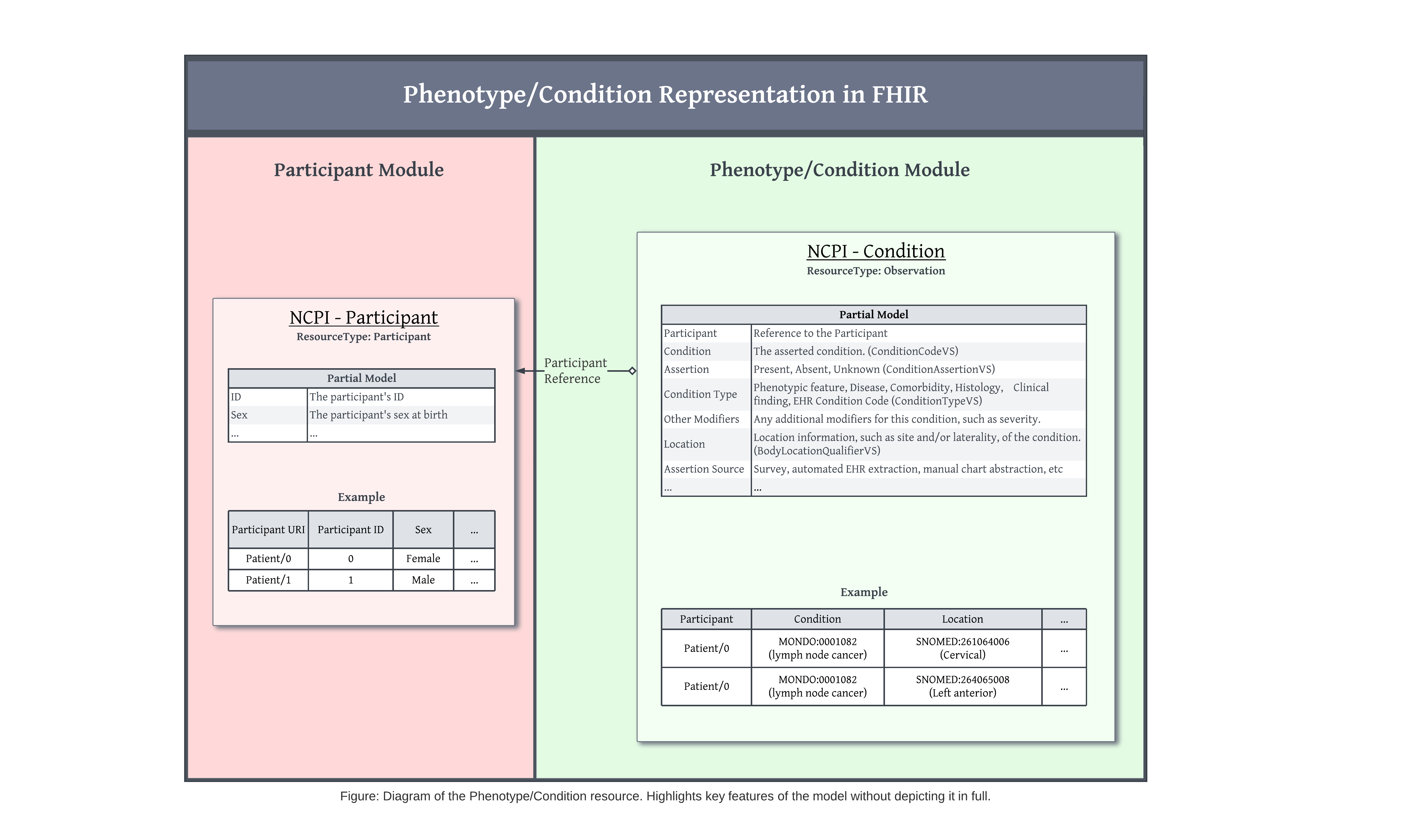
ncpi_phenotype_condition_module.png
|
|
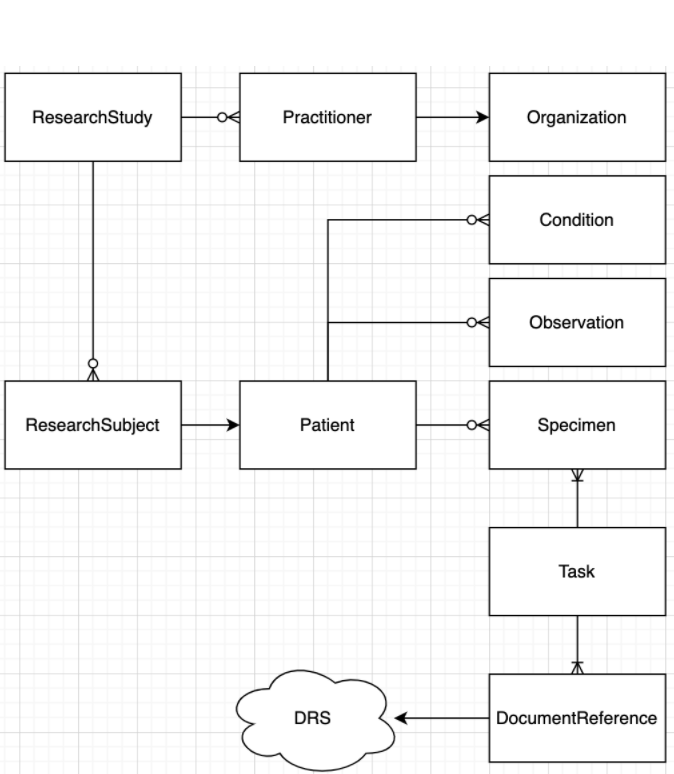
research-study-structure.png
|
|
tree-filter.png
|